Explainer Video
The Commonwealth of Dominica is undergoing an unprecedented structural metamorphosis, centered on the construction of a new international airport in the Wesley-Woodford Hill region. This project—the largest in the history of the Eastern Caribbean—is not merely a piece of civil engineering but a strategic pivot intended to redefine the socio-economic and geopolitical trajectory of the "Nature Island."
However, the advancement of this project has surfaced a profound national debate regarding not only technical and environmental concerns but fundamental questions of social equity, indigenous rights, community consultation, and the ethical balance between modernization and preservation. This explainer examines these multidimensional challenges through six critical lenses.
Economic
CBI financing, tourism projections, IMF assessments
Technical
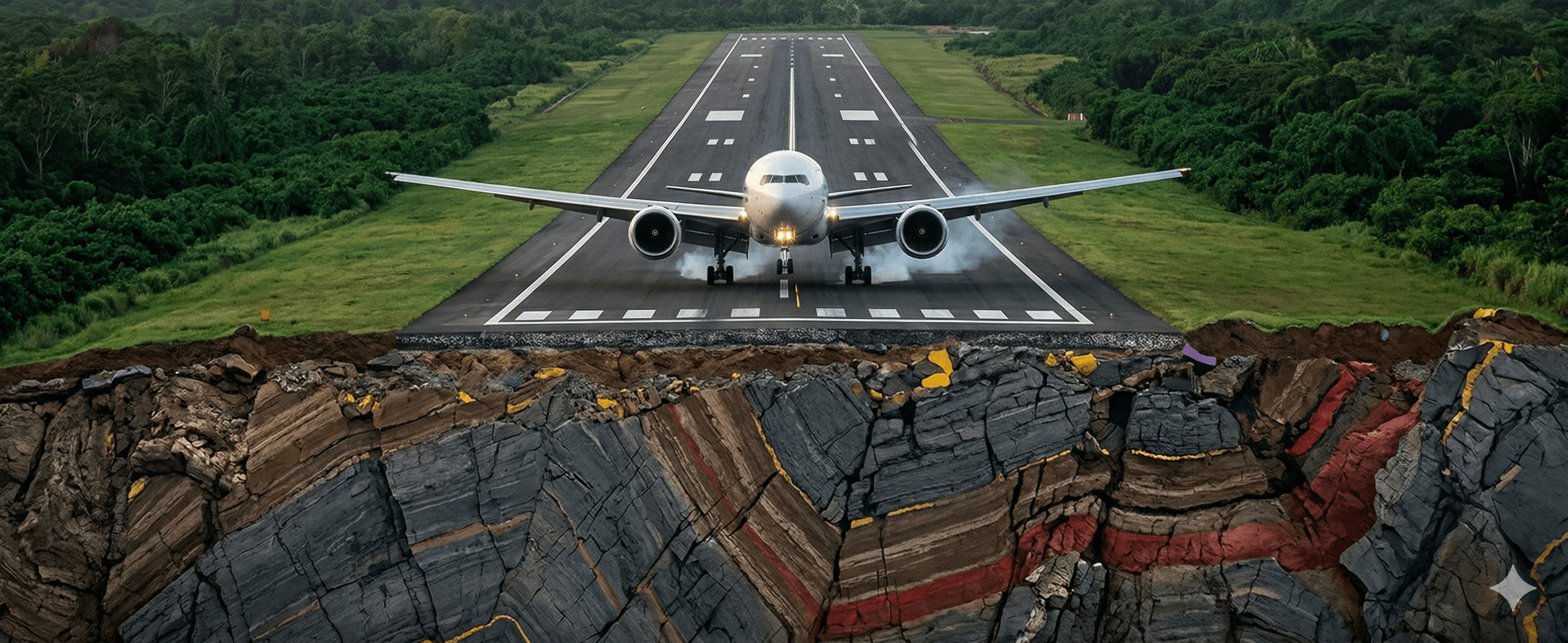
Runway standards, aggregate quality, geotechnical integrity
Political
No-bid contracts, transparency, contractor records
Social
Wesley displacement, compensation, heritage loss
Indigenous Rights
Kalinago consultation, FPIC, ILO Convention 169
Ethical
Nature Island paradox, mining suspicion, climate resilience
The Economic Dimension
The economic rationale for the Dominica International Airport (DIA) is predicated on removing the "access challenge"—a long-standing constraint that has limited tourism arrivals and trade capacity. The financing model through Citizenship by Investment (CBI) is portrayed as avoiding traditional debt while critics question the sustainability of relying on this volatile revenue stream.
Visual explaining the "creative financial mechanism" connecting CBI revenue to infrastructure development
IMF Economic Assessment (2024-2026)
Key macroeconomic indicators during airport construction
| Indicator | 2024 | 2025 | 2026 (Projected) |
|---|---|---|---|
| Real GDP Growth | 3.5% | 4.5% | 3.0% |
| Inflation (Average) | 3.1% | 2.3% | 2.0% |
| Public Debt (% of GDP) | 100% | 103% | 96.9% |
| Current Account Deficit (% of GDP) | 32.2% | 38.0% | 30.4% |
| Primary Fiscal Balance (% of GDP) | -2.0% | -4.5% | +0.7% |
Tourism Target: 500,000 Visitors by 2030
In 2025, Dominica achieved 488,091 total arrivals (49% increase over 2019) with 112,195 stay-over visitors generating an estimated EC$381 million in direct spending. The government projects that the airport will unlock EC$1 billion+ in annual tourism revenue once operational in 2027.
The Political Dimension
The political discourse surrounding the airport is defined by concerns over the "no-bid" contract awarded to MMCE and the involvement of China Railway No. 5, a contractor with a documented history of international debarment for fraudulent practices.
Visual timeline showing China Railway No. 5's debarments by international financial institutions
International Sanctions Against CR5 Affiliates
Major debarments by multilateral development banks
| Entity | Sanctioning Body | Violation | Period |
|---|---|---|---|
| CRCC & Subsidiaries | World Bank | Fraudulent Practice (Georgia Highway) | 2019-2022 |
| China Railway Const. Eng. | AfDB | Fraudulent Practice (Tanzania Airport) | 2024-2025 |
| China Henan Int. Coop. | AfDB | Fraudulent Practice | 2024-2025 |
The Social Dimension: Wesley Displacement
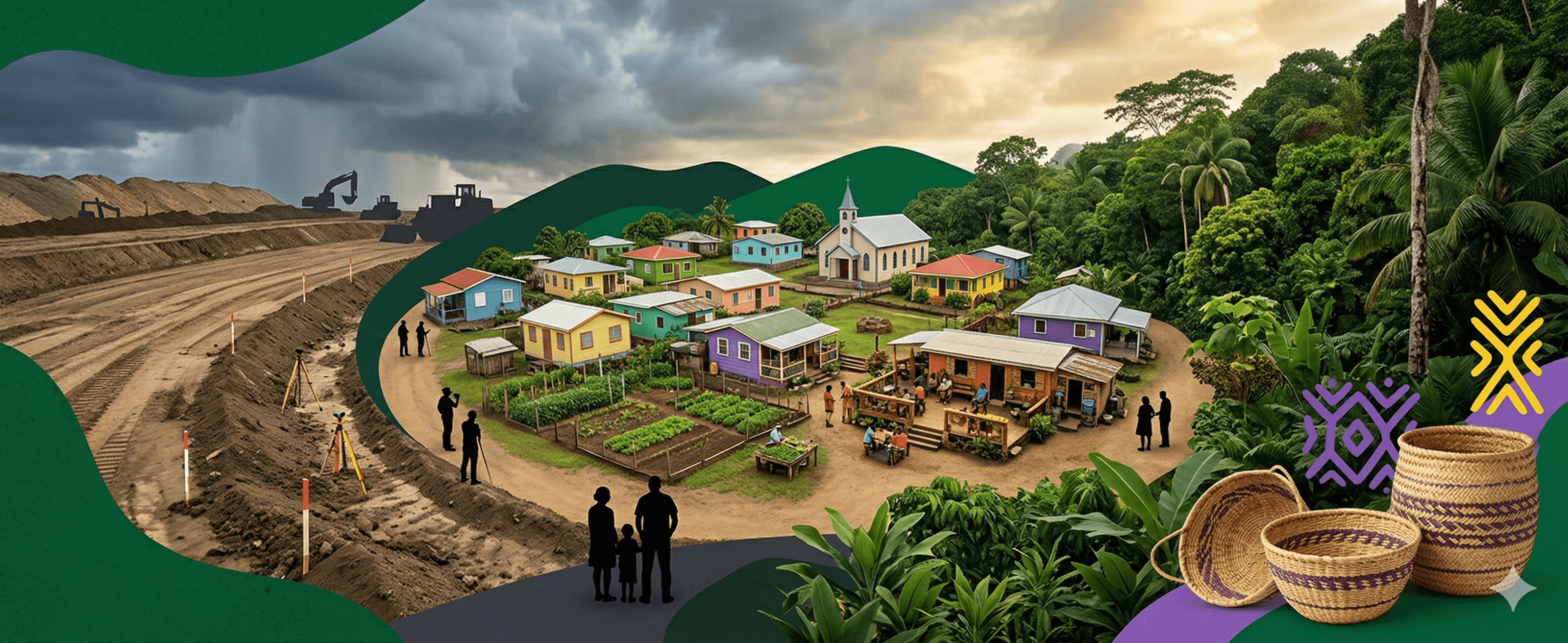
The construction of the airport in Wesley has required the acquisition of over 230 private properties, fundamentally altering the social fabric of the village. While the government emphasizes compensation and relocation, residents voice deep grievances about heritage loss and inadequate consultation.
Side-by-side comparison of Wesley village layout before and after airport construction
Wesley Community Impact
Social and economic transformation metrics
| Metric | Data Point |
|---|---|
| Properties Acquired | Over 230 |
| Compensation Disbursed | Over EC$45 Million (US$16.6M+) |
| Property Owners Paid | 235 |
| New Homes Constructed (Jo Burton) | 47 |
| Displaced Houses | Over 70 |
Community Voices
"I built this house for my retirement. Now I have to leave. They didn't ask us if there was another way." — Jenner David, Displaced Resident
The Wesley Development Organization has petitioned the government, citing the permanent destruction of heritage, loss of beach access, and destruction of fisherfolk livelihoods. They argue that alternative sites could have avoided "obliterating" the residential core of the village.
Indigenous Rights: The Kalinago Consultation Dispute
The impact on the Kalinago Territory, located in proximity to the Deux Branches quarry, has become a focal point in the debate over Free, Prior, and Informed Consent (FPIC). Kalinago Chief Annette Sanford has publicly challenged claims that the Council was consulted during the ESIA process.
Visualization of Kalinago Territory in relation to Deux Branches and FPIC consultation requirements under international law
ILO Convention 169 & FPIC
Dominica ratified ILO Convention 169 in 2002, requiring the state to obtain Free, Prior, and Informed Consent (FPIC) from indigenous peoples before undertaking projects that affect their resources or livelihoods.
Chief Sanford's assertion that "no actual consultations took place" despite the Council being listed as a stakeholder in the June 2025 ESIA raises serious questions about compliance with international obligations and the principle of good-faith consultation through representative institutions.
The Ethical Dimension: The "Nature Island" Paradox
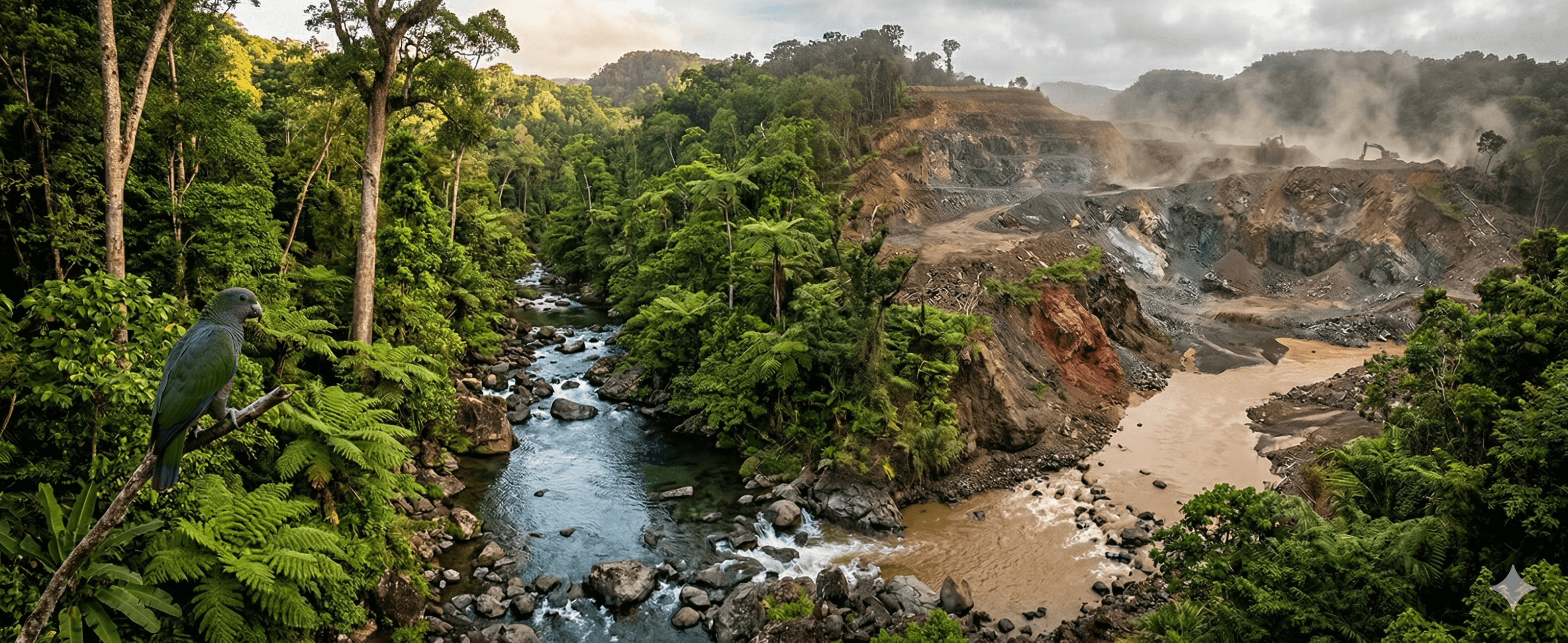
The airport quarry issue presents a profound ethical dilemma: how does a nation that brands itself as the "Nature Island" reconcile a massive, high-impact infrastructure project with its commitment to environmental stewardship?
Diagram exploring the tension between "Nature Island" branding and large-scale development projects
Government Position
"We must responsibly use a small portion of our own resources to build for the future of our children, rather than damaging the environment of another country by importing materials. This is a principled approach that takes responsibility for the unavoidable ecological footprint of development."
Critics' Position
"The presence of copper at Deux Branches and the scale of operations suggest this may be a 'pretext for mining'—raising the specter of the 1996 BHP copper mining proposal that was rejected due to fears of environmental disaster. Are we witnessing the same project under a different name?"
Comparative Case Study: St. Vincent's Argyle Airport
To contextualize the DIA project, we can look at the Argyle International Airport (AIA) in St. Vincent and the Grenadines, which opened in 2017. The AIA was also a massive capital project that transformed tourism but faced initial fiscal challenges before achieving profitability in 2024.
Comparative analysis of St. Vincent's Argyle Airport (debt-financed) vs. Dominica's model (CBI-financed)
Lessons from St. Vincent
In 2024, AIA achieved an operating profit of EC$4.05 million with EC$28 million in revenue after years of government subventions. The airport was built for ~EC$400 million using traditional debt financing. Dominica's CBI model aims to avoid this debt burden, but the volatility of CBI inflows creates different risks that could jeopardize completion of "macro-critical" projects.
Navigating the Multidimensional Challenge
The Dominica International Airport represents a microcosm of the challenges facing Small Island Developing States as they pursue modernization. The project is a strategic attempt to bridge the "access gap" and unlock a billion-dollar tourism economy, funded through an innovative but volatile Citizenship by Investment program.
The quarry dispute highlights a significant trust deficit regarding technical quality, environmental transparency, and community consultation. While the government emphasizes the economic and moral logic of using local resources, valid geotechnical, legal, and social concerns have been raised that demand transparent resolution.
Ultimately, the airport's success will be measured not only by the arrival of direct flights from London or New York but by the government's ability to demonstrate that development did not come at the cost of environmental integrity, indigenous rights, or the social fabric of its communities. The ongoing debate remains a test case for how Dominica balances its "Nature Island" identity with its ambitions for a modern future.
Social & Ethical Quiz
Score 70% or higher to earn a badge
Sign in to take quizzes and earn badges
Sign InMore Explainers

You've read all four explainers
Now See the Plan
The Greenprint shows how Dominica can build the airport it needs while protecting the island it loves.
Read the Greenprint