Explainer Video
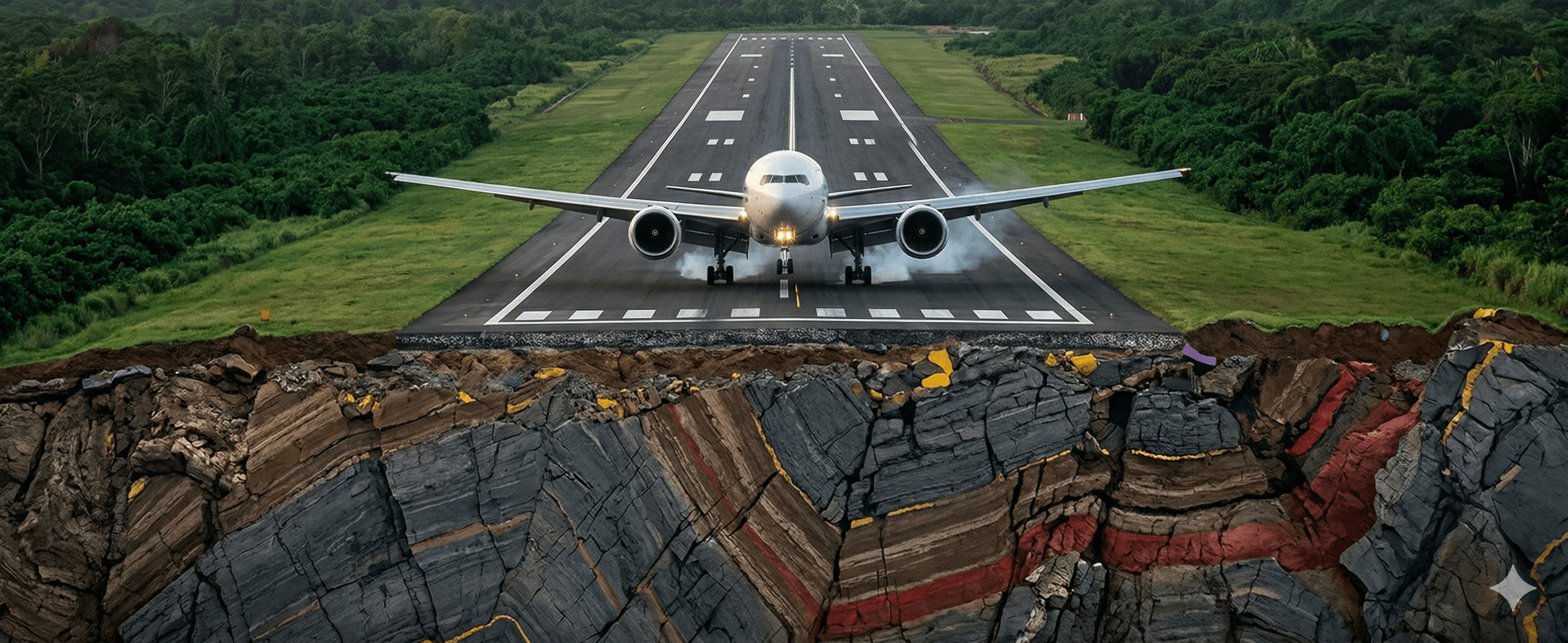
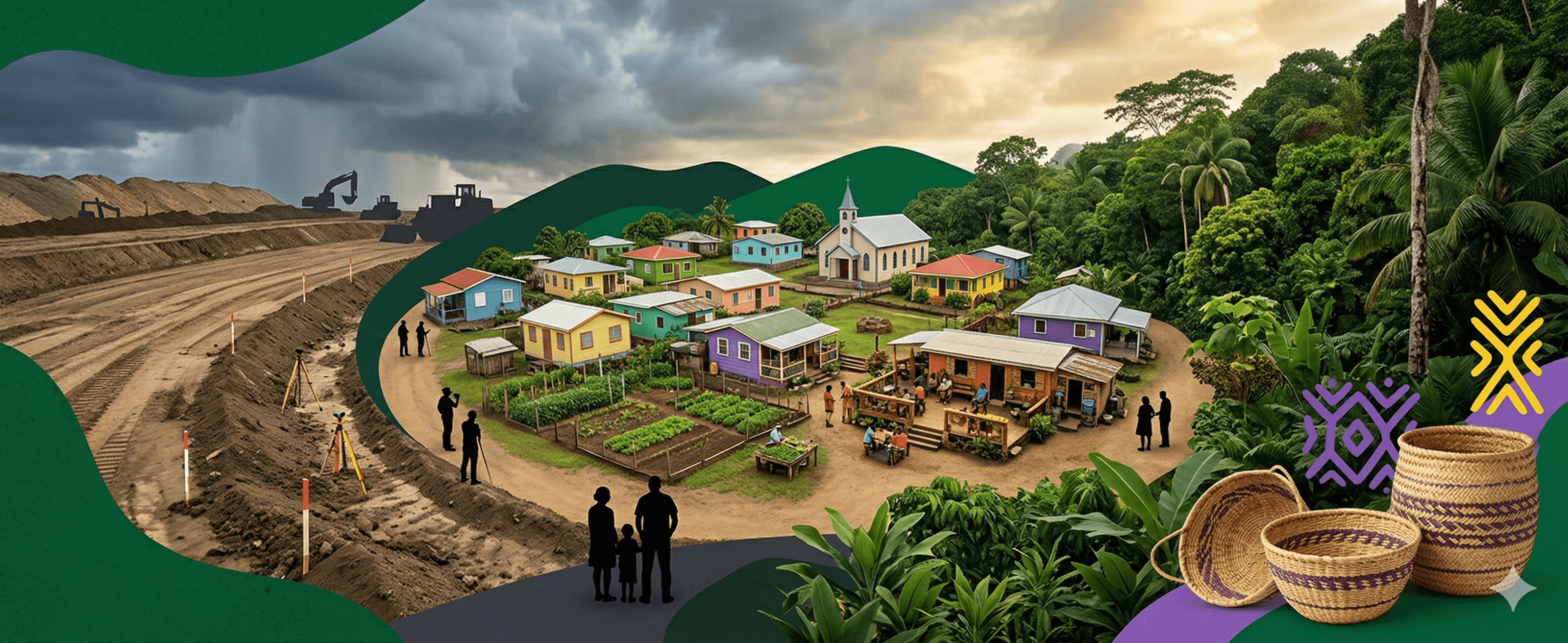
The Commonwealth of Dominica is navigating the most significant infrastructure development in its modern history: the construction of the Dominica International Airport in Wesley. This massive project, valued at over one billion EC dollars and primarily funded through the nation's Citizenship by Investment (CBI) program, aims to establish a 3,000-meter runway capable of supporting wide-body aircraft.
At the heart of a profound scientific debate lies the suitability of volcanic rock being sourced from the Deux Branches site (also known as the Stonefield Quarry) for the rigorous engineering requirements of an international runway.
The Central Question
Is the volcanic rock at Deux Branches quarry suitable for constructing a runway that must safely carry wide-body aircraft for decades to come? Or has hydrothermal alteration and geological heterogeneity rendered the material unsuitable for aviation-grade construction?
Dominica's Unique Geological Setting
To evaluate the suitability of any Dominican rock for high-grade construction, one must first understand the island's unique position within the Lesser Antilles volcanic island arc. Dominica represents the surface expression of complex tectonic interactions and features the highest concentration of potentially active volcanic centers in the Caribbean.
Dominica's Volcanic History
26 million years of volcanic activity shaped the island's geology
| Division | Age | Rock Type | Character |
|---|---|---|---|
| Division 1 (Miocene) | 6.92 – 5.22 Ma | Low-K Basaltic Terranes | Deeply weathered, dissected foundations found on the east coast |
| Division 2 (Pliocene) | 3.7 – 2.76 Ma | Basalt and Andesite | Remnants of large stratovolcanoes; heavily eroded |
| Division 3 (Older Pleistocene) | 1.7 – 1.0 Ma | Andesite and Dacite | Development of massive domes in the northern half of the island |
| Division 4 (Younger Pleistocene – Recent) | 0.77 Ma – Present | Andesites and Dacites | Pelean-style domes and ignimbrite deposits in the south |
The island's earliest foundations—the Miocene basalts of Division 1—are concentrated along the Atlantic coast and have been subjected to millions of years of tropical weathering. This history of explosive activity and dome growth means that much of the bedrock is not a uniform solid mass but a complex mosaic of lava flows, ash falls, and hydrothermal deposits.
Simplified geological cross-section showing Dominica's layered volcanic history
Science of Construction Aggregates
In civil engineering, the mineralogical and physical properties of aggregate determine the safety and longevity of runway pavement. The primary rock types in Dominica—basalt, andesite, and dacite—are classified by their silica content, which dictates density, hardness, and resistance to chemical breakdown.
Volcanic Rock Classification
How silica content affects construction suitability
| Rock Type | Silica Content | Properties | Typical Minerals |
|---|---|---|---|
| Basalt (Mafic) | 45% – 52% | Low viscosity, high density | Olivine, Pyroxene, Plagioclase |
| Andesite (Intermediate) | 52% – 66% | Moderate viscosity, high strength | Plagioclase, Amphibole, Pyroxene |
| Dacite (Silicic) | > 66% | High viscosity, lower density | Quartz, Plagioclase, Mica |
Why Rock Type Matters
Basalt and high-density andesite are preferred for runways because their mineral structures involve interlocking crystals of pyroxene and plagioclase, providing high compressive strength and low porosity. However, a critical factor in Dominica is not just the original rock type, but its secondary alteration.
Visual comparison of the three main volcanic rock types found in Dominica
The Hydrothermal Trap: Why Solid Rock Weakens
On a geologically active island, bedrock is frequently exposed to hydrothermal systems—underground networks where magma heats groundwater, creating acidic, mineral-rich fluids. These fluids circulate through cracks in volcanic rock, causing chemical reactions that transform hard minerals like feldspar into soft clay minerals like kaolinite or jarosite.
Argillic Alteration Process
Hydrothermal fluids penetrate rock
Heated groundwater moves through fractures and joints
Chemical leaching occurs
Cations (sodium, magnesium) are removed from minerals
Mineral replacement takes place
Hard feldspar becomes soft clay minerals (kaolinite)
Structural weakening results
Brittle material with micro-cracks and soft rinds forms
This process, known as argillic alteration, is the primary source of the scientific debate at Deux Branches. When rock appears solid to the naked eye but possesses internal micro-cracks and soft rinds, it can crumble under the repetitive stress cycles of heavy aviation traffic.
How hydrothermal alteration transforms strong rock into weakened, clay-rich material
Weathered volcanic rock showing internal weaknesses from hydrothermal alteration
The Deux Branches Debate
The Deux Branches site, located at the confluence of river systems in the Concord area, was selected by developers MMCD and contractor CR5 as a primary source of aggregate for the international airport. Its proximity to the Wesley construction site is a major logistical advantage.
Government & Developer Position
The official stance is that Deux Branches provides high-quality stone meeting stringent technical requirements for runway construction.
Key Arguments:
- ✓Andesitic Superiority: High-density andesite, ideal for runways and sea-defense armor
- ✓Historical Precedent: Hatton Garden–Portsmouth road allegedly used this stone with exceptional durability
- ✓Economic Reality: Importing aggregate from overseas is economically absurd and fiscally irresponsible
Scientific Opposition
Led by Prof. Simon Mitchell (UWI)
Independent geological assessment raises serious alarms about critical structural and chemical flaws in the material.
Key Concerns:
- ⚠Geological Heterogeneity: Mixed rock types weakened by hydrothermal alteration and weathering
- ⚠Brittleness & Instability: Ancient hydrothermal springs rendered rock prone to fracture
- ⚠Copper Mineralization: Raises concerns about whether quarry is pretext for mining
- ⚠Disputed History: Claim that Hatton Garden road used Colihaut stone, not Deux Branches
Engineering Standards for International Runways
Runways are not simply "wide roads"—they are sophisticated multi-layered structures designed to distribute massive wheel loads over a broad surface area. The standards set by ICAO and FAA are rigorous.
Runway vs. Highway: Loading Comparison
| Design Parameter | Standard Highway | International Runway |
|---|---|---|
| Wheel Load | ~2,000 kg (4,500 lb) | >29,000 kg (60,000 lb) |
| Tire Pressure | 0.5 – 0.8 MPa (80-120 psi) | 1.0 – 1.7 MPa (150-250 psi) |
| Pavement Thickness | ~0.5 meters | >2.5 meters |
| Surface Texture | Flexible for traction/braking | Rigid or grooved for high-speed friction |
Critical Aggregate Tests
1. L.A. Abrasion Test (ASTM C131)
Measures resistance to crushing and wear. Maximum allowed loss: 25-30% for high-quality airport asphalt. Hydrothermally altered rock may exceed these limits.
2. Specific Gravity and Absorption
High-density rocks have lower absorption rates. Rock must be dense enough to prevent moisture infiltration that can lead to pavement stripping.
3. Soundness (Magnesium Sulfate)
Evaluates resistance to weathering. Poorly lithified rock would show high mass loss after five cycles.
Professor Mitchell's concern: "Rigorous certification tests for these materials appear non-existent," suggesting a potential breach of ICAO safety protocols. Without transparent, third-party verified test results, the long-term structural integrity of the Wesley runway remains uncertain.
Cross-section of an international runway showing how aircraft loads are distributed through aggregate layers
West Coast Alternatives: Colihaut and Layou
While the government argues that Deux Branches is the only viable site, critics and historical evidence point toward the west coast as a more reliable source of uniform rock.
Advantages of West Coast Sourcing (Colihaut)
- ✓Lithological Uniformity: Well-suited to modern construction needs with consistent density and chemical stability
- ✓Historical Success: The Hatton Garden road's superior performance may prove this material's suitability
- ✓Rockfall Hazard Mitigation: Breaking down steep cliffs reduces falling rocks on coastal highway
The Logistical Challenge
Transporting millions of tons from Colihaut to Wesley involves significant "carbon miles" and physical degradation of the national road network. Crossing the trans-island road with hundreds of heavy truck loads daily would introduce severe traffic congestion and maintenance costs that developers wish to avoid.
Environmental and Hydrological Impacts
Beyond the engineering debate lies a critical environmental concern: the impact of large-scale quarrying on the hydrology and soil stability of the Pagua River watershed, which provides 10 million gallons per day to communities in Concord, Stonefield, and the Kalinago Territory.
Soil Degradation from Quarrying
Measured chemical changes in quarried watersheds
| Soil Property | Impact of Quarrying | Long-term Consequence |
|---|---|---|
| Soil pH | Severe Alkalinization (up to pH 9.0) | Reduced availability of essential nutrients for plants |
| Conductivity | High Salinization (up to 7,900 µS/cm) | Soil becomes "dead" and cannot support forest regeneration |
| Organic Matter | Drop to as low as 0.05% | Total loss of soil fertility and biodiversity support |
| Carbonates | High precipitation (up to 80%) | Altered physical structure; increased soil hardness |
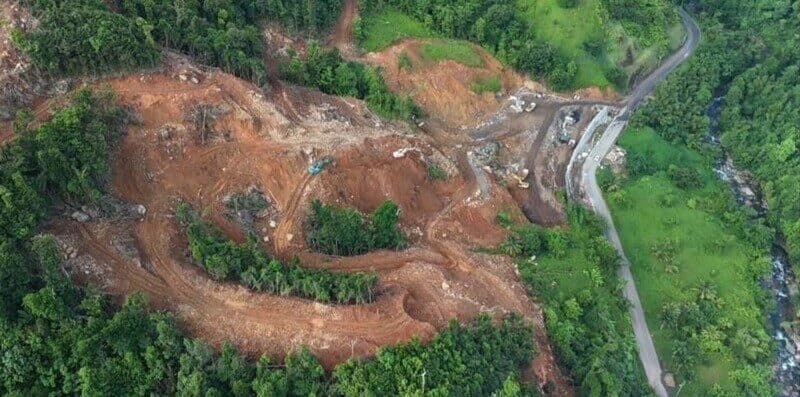
The Deux Branches quarry operation near Concord, showing the scale of rock extraction for the airport project
Hydrological Impacts
- 1
Runoff "Flashiness"
Lag times can drop from 4 hours to 1 hour, meaning rivers respond faster and more violently to rain events
- 2
Dewatering and Storage Loss
Deep excavations depress the water table, leading to loss of springs and failure of domestic wells downstream
- 3
Disruption of Conduit Flow
Blasting penetrates groundwater conduits, diverting water into quarry floor where it's contaminated by stone dust and oils
Mitigation and Engineering Controls
In response to public outcry, the Government of Dominica and MMCE Ltd have implemented engineered safeguards at the Deux Branches site to align with the Physical Planning Act and international best practices.
Structural Interventions
- ⬥Reinforced Retaining Wall: Ensures slope stability and safety of personnel
- ⬥Siltation Ponds: Tiered ponds trap stone dust and reduce turbidity before runoff enters river
Environmental Controls
- ⬥Closed-Loop Water Filtration: Water is filtered and recycled rather than discharged
- ⬥Automated Misting Cannons: Dust suppression to protect Northern Forest Reserve
Regulatory Concerns
Critics argue that the project lacked a full Environmental Social Impact Assessment (ESIA) at its inception, violating the principles of the Escazú Agreement, which Dominica ratified in 2024. This agreement legally requires the state to provide timely environmental information and guarantee public participation.
The Path Forward
The scientific debate regarding the rock at Deux Branches is a collision of two valid professional imperatives: the need for an efficient, localized source of high-volume aggregate to build a transformational national asset, and the requirement for geological uniformity and environmental integrity to safeguard the traveling public and the island's natural resources.
From an engineering standpoint, if assessments are correct, the high-density andesite at Deux Branches offers superior strength while minimizing carbon footprint. However, the geological critique cannot be ignored. The presence of hydrothermal alteration and mixed rock types suggests high risk of aggregate failure.
The path forward requires a transition from speculation to rigorous, transparent science. Ensuring that all aggregate undergoes independent, multi-party geotechnical validation is the only way to safeguard future air travelers and Dominica's environmental heritage. Development and environmental protection are not inherently opposed, but they must be reconciled through scientific sovereignty and institutional accountability.
Related Resources
Runway Rock Debate Quiz
Score 70% or higher to earn a badge
Sign in to take quizzes and earn badges
Sign InMore Explainers
Next in the series
Legal Analysis
Now that you understand the geology, explore the legal frameworks and rights at stake.
Continue to Legal Analysis