
Explainer Video
The Commonwealth of Dominica stands at a critical juncture in its post-colonial developmental trajectory, defined by the tension between the construction of a US$370 million international airport and the preservation of its ecological and indigenous heritage. This project, the largest in the nation's history, is primarily funded through the Citizenship by Investment (CBI) programme and managed under an Engineering, Procurement, and Construction (EPC) model.
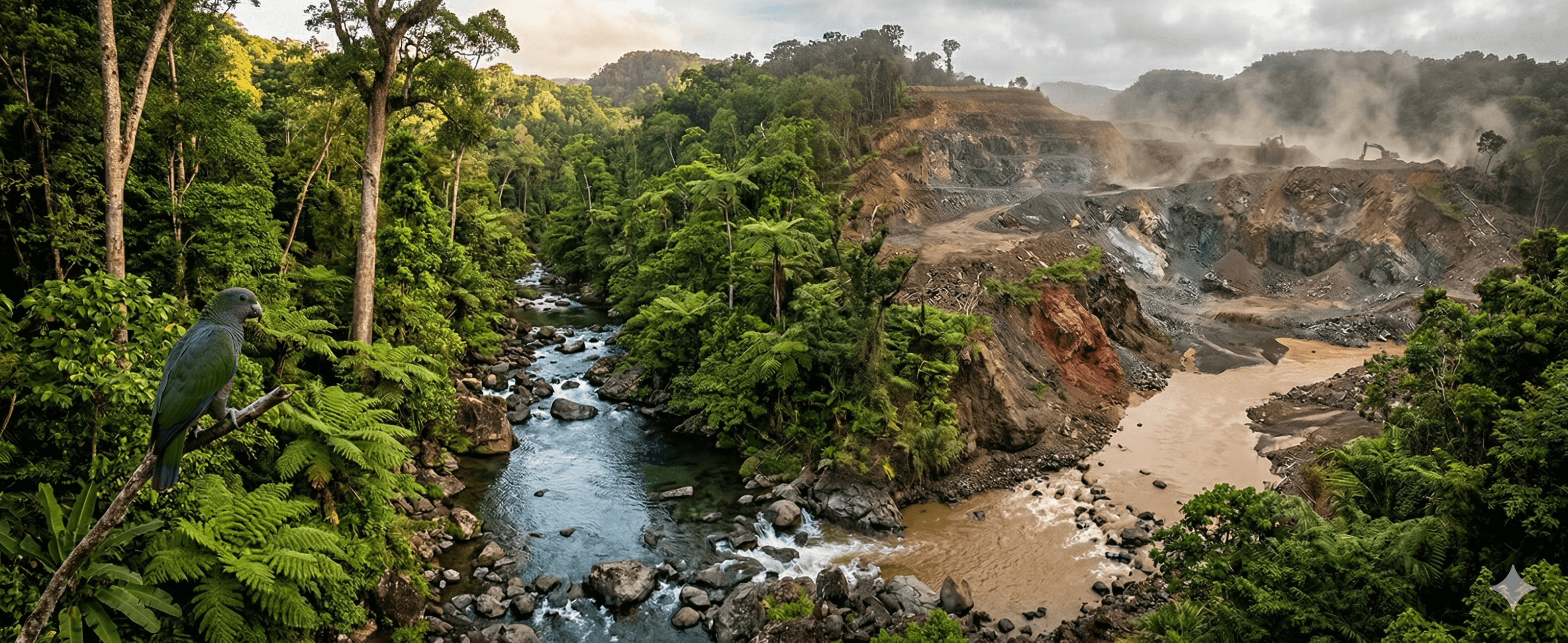
At the center of the current legal friction is the Deux Branches (or Stonefield) quarry, located near Concord, which serves as the primary source of basalt aggregate for the airport's 3,000-meter runway. This analysis provides a thorough legal and regulatory examination of the project, exploring contractual governance, administrative law breaches, geological suitability, and the rights of the indigenous Kalinago people.
The Central Legal Question
Has the Government of Dominica and its development partners complied with statutory requirements for environmental impact assessments, indigenous consultation, and administrative transparency? Or have procedural improprieties and breaches of international obligations undermined the legal foundation of the quarrying operations?
Contractual Governance and the EPC Paradox
The project's legal structure is predicated on the relationship between the Government of Dominica, the developer Montreal Management Consultants Development Ltd (MMCD), and the primary contractor China Railway No. 5 (CR5). The selection of an EPC model, or "turnkey" contract, transfers the preponderance of design, procurement, and construction risk to the contractor in exchange for a fixed price.
Visual diagram of the contractual relationships and risk allocation in the airport project
Key Legal Entities
Roles and responsibilities in the airport project
| Entity | Primary Role | Legal Context |
|---|---|---|
| Government of Dominica | Project Owner and Regulator | Oversight via Physical Planning Division; CBI funding |
| MMCD | Project Developer | Management and procurement; initiated arbitration |
| China Railway No. 5 | Main Contractor | Subject to international sanctions; aggregate sourcing driver |
| Physical Planning Authority | Statutory Regulator | EIA oversight and Stop Order enforcement |
| Kalinago Council | Indigenous Local Government | Custodian of the adjacent Kalinago Territory |
The Arbitration Crisis
In March 2026, the contractual stability of the airport project was undermined when MMCD initiated formal arbitration proceedings against the Government of Dominica. Project Director Cal Murad characterized the arbitration as a "last resort," citing "persistent and significant breaches" of several development contracts. Murad warns this could lead to the "gravest possible outcome"—the suspension of the airport project and associated housing developments.
Administrative and Environmental Legal Friction
The sourcing of aggregate from the Deux Branches quarry has generated a complex web of administrative law challenges, primarily centered on the Physical Planning Act of 2002. Activists from the "Save Deux Branches Campaign" argue that the government and developers have systematically bypassed statutory requirements for transparency and public participation.
Flowchart showing the statutory requirements for environmental impact assessments under the Physical Planning Act
Procedural Impropriety and the ESIA Process
The Physical Planning Act mandates that Environmental Impact Assessments (EIAs) be conducted for developments likely to cause significant ecological harm, explicitly including quarrying and infrastructure projects like airports. However, the Environmental and Social Impact Assessment (ESIA) for the Deux Branches quarry is alleged to be subject to severe procedural impropriety.
Access Restrictions
Critics point to the restriction of access to the ESIA documents. According to activist reports, the Physical Planning Division provided only three physical copies of the ESIA at its office in Roseau, limiting viewing time to 1.5 hours per person. No digital copies were initially made available online, and no physical copies were placed within the Kalinago Territory—the community most directly impacted.
This restriction is a potential violation of the state's statutory duties of transparency and the "principle of maximum disclosure" enshrined in regional treaties.
Enforcement and the December 2025 Stop Order
Key Enforcement Milestones
Timeline of regulatory actions and responses
| Milestone | Date | Significance |
|---|---|---|
| Quarry Application Submitted | July 31, 2025 | Initial filing under the Physical Planning Act |
| Stop Order Issued | December 1, 2025 | Cited unauthorized activity and river pollution |
| PM Site Visit | December 4, 2025 | Temporary halt ordered pending review |
| Crushing Plant Approval | March 6, 2026 | Separate application granted; quarry remains pending |
| Operations Resume | March 2026 | Activists challenge legality given the Stop Order |
Indigenous Rights and the Kalinago Territory
The Deux Branches site is adjacent to the Kalinago Territory, and the impact on the indigenous population has raised profound human rights and jurisdictional issues. The Kalinago Territory Act of 1978 grants the Kalinago Council "custody, management, and control" of the lands within the reserve.
Geographical relationship between the Kalinago Territory and the Deux Branches quarry site
Free, Prior, and Informed Consent (FPIC)
Kalinago Chief Annette Sanford has stated that the council was not substantively consulted regarding the quarry, receiving only a single notification email. This lack of meaningful engagement is a violation of international standards, specifically ILO Convention 169, which Dominica ratified in 2002.
ILO Convention 169: Key Requirements
ILO 169 requires states to obtain the Free, Prior, and Informed Consent (FPIC) of indigenous peoples before undertaking projects that affect their resources or livelihoods. The Caribbean Court of Justice (CCJ) has established robust jurisprudence in this area, notably in Maya Leaders Alliance v AG of Belize, where the court recognized that customary indigenous land rights are constitutionally protected.
The degradation of the Pagua River—a communal resource for the Kalinago—could be argued as a deprivation of property under Section 6 of the Dominica Constitution.
Legal Protections for Indigenous Rights
Applicable statutes and treaties
| Statute / Treaty | Key Protection | Application |
|---|---|---|
| Kalinago Territory Act 1978 | Custody and control of reserve land | Establishes Council's jurisdictional authority |
| ILO Convention 169 | Free, Prior, and Informed Consent | Mandates substantive consultation |
| Dominica Constitution (S. 6) | Protection from deprivation of property | Relevant to pollution of communal water |
| Dominica Constitution (S. 8) | Right to a fair hearing | Applies to environmental decisions |
Regional Jurisprudence and the Escazú Agreement
Dominica's ratification of the Escazú Agreement in 2024 introduces binding regional obligations regarding environmental democracy. The Agreement guarantees the public's right to access environmental information, participate in decision-making, and access justice.
Visual breakdown of the Escazú Agreement's three pillars of environmental democracy
Standing and the Duty of Candour
The Privy Council's 2024 judgment in Mussington v Development Control Authority (Antigua and Barbuda) provides a critical precedent. The court overturned a restrictive standing rule, allowing local residents with "sufficient interest" to challenge environmental permits even without a direct proprietary interest or scientific expertise.
This ruling suggests that activists have strong legal standing to seek judicial review. Furthermore, the "Duty of Candour" requires public authorities to be fully transparent during such reviews. The government's restriction of the ESIA document could be challenged as a breach of this duty.
Constitutional and Administrative Avenues for Redress
For parties seeking to challenge the quarrying operations, several judicial strategies are available:
1Judicial Review (CPR Part 56)
Applicants can seek an interim injunction to halt quarrying based on "procedural impropriety" (failure to consult the Kalinago) and "irrationality" (approving a quarry in a primary watershed despite evidence of hydroth ermal alteration).
2Constitutional Motion (Section 16)
An originating motion can be filed alleging violations of Section 6 (protection from uncompensated deprivation of property via river pollution) and Section 8 (the right to a fair hearing regarding environmental decisions).
3CCJ Intervention
Given Dominica's accession to the CCJ's appellate jurisdiction, the Maya Leaders Alliance precedent can be leveraged to argue that the state has failed its positive obligation to protect indigenous land and water rights.
4Administrative Law Challenge on Categorization
If it can be proven that the operation is mining minerals under a quarrying permit, the permit can be quashed as an ultra vires act—an exercise of power beyond the state's legal authority.
Path Forward: Just and Balanced Resolution
A just resolution to the airport quarry issue requires a careful balancing of national infrastructure development with the fundamental rights of the environment and the indigenous Kalinago people. The current project status, with significant completion percentages, makes a total halt economically devastating. However, the legal and environmental violations are too significant to ignore.
The framework for stabilization must include transparent environmental assessments, meaningful indigenous consultation adhering to FPIC standards, independent geological verification, and robust administrative compliance with all statutory requirements. Only through such comprehensive legal stewardship can Dominica achieve both its development aspirations and its obligations to protect its natural and cultural heritage.
Legal Analysis Quiz
Score 70% or higher to earn a badge
Sign in to take quizzes and earn badges
Sign InMore Explainers

The Runway Rock Debate
Geological integrity and engineering analysis of the Deux Branches quarry aggregate.
Environmental Impact
Watershed disruption, biodiversity threats, and toxic metal mobilization risks.

Social & Ethical Dimensions
Community displacement, indigenous rights, and the Nature Island paradox.
Next in the series
Environmental Impact
Understand how the legal gaps translate into real environmental consequences.
Continue to Environmental Impact